B201 The Intention Experiment by Lynne McTaggart Sec 1
Chapter 1
Mutable Matter
FEW PLACES IN THE GALAXY are as cold as the helium-diluti refrigerator in Tom Rosenbaum’s lab.
Temperatures in the refrigerator – a boiler- sized circular apparatus with a number of cylinders – can descend to a few thousandths of a degree above absolute zero, almost 273°C below freezing – three thousand times colder than the farthest reaches of outer space.
For two days, liquid nitrogen and helium circulate around the refrigerator, and then three pumps constantly blasting out gaseous helium take the temperature down to the final rung. Without heat of any description, the atoms in matter slow to a crawl.
At this scale of coldness, the universe would grind to a halt. It is the scientific equivalent of hell freezing over.
Absolute zero is the preferred temperature of a physicist like Tom Rosenbaum.
At 47, as a distinguished professor of physics at the University of Chicago and former head of the James Franck Institute, Rosenbaum was in the vanguard o experimental physicists who liked exploring the limits of disorder in condensed- matter physics, the study of the inner workings of liquids and solids when their underlying order was disturbed.[1]
In physics, if you want to find out how something behaves, the best way is simply to make it uncomfortable and then see what happens.
Creating disorder usually involves adding heat or applying a magnetic field to determine how it will react when disturbed and also to determine which spin position – or magnetic orientation – the atoms will choose.
Most of his colleagues in condensed-matter physics remained interested in symmetrical systems such as crystalline solids, whose atoms are arranged in orderly array, like eggs in a carton, but Rosenbaum was drawn to strange systems that were inherently disordered – to which more conventional quantum physicists referred disparagingly as ‘dirt’.
In dirt, he believed, lay exposed the unprobed secrets of the quantum universe, uncharted territory that he was happy to navigate.
He loved the challenge posed by spin glasses, strange hybrids of crystals, with magnetic properties, technically considered slow-moving liquids. Unlike a crystal, whose atoms point in the same direction in perfect alignment, the tiny magnets associated with the atoms of a spin glass are wayward and frozen in disarray.
The use of extreme coldness allowed Rosenbaum to slow down the atoms of these strange compounds enough to observe them minutely, and to tease out their quantum mechanical essence. At temperatures near to absolute zero, when their atoms are nearly stationary, they begin taking on new collective properties.
Rosenbaum was fascinated by the recent discovery that systems disorderly at room temperature display a conformist streak once they are cooled down. For once, these delinquent atoms begin to act in concert.
Examining how molecules behave as a group in various circumstances is highly instructive about the essential nature of matter.
In my own journey of discovery, Rosenbaum’s laboratory seemed the most appropriate place to begin. There, at those lowest temperatures where everything occurs in slow motion, the true nature of the most basic constituents of the universe might be revealed. I was looking for evidence of ways in which the components of our physical universe, which we think of as fully realized, are capable of being fundamentally altered.
I also wondered whether it could be shown that quantum behaviour like the observer effect occurs outside the subatomic world, in the world of the everyday. What Rosenbaum had discovered in his refrigerator might offer some vital clues as to how every object or organism in the physical world, which classical physics depicts as an irreversible fact, a finalized assemblage only changeable by the brute force of Newtonian physics, could be affected and ultimately altered by the energy of a thought.
According to the second law of thermodynamics, all physical processes in the universe can only flow from a state of greater to lesser energy. We throw a stone into a river and the ripple it makes eventually stops. A cup of hot coffee left standing can only grow cold.
Things inevitably fall apart; everything travels in a single direction, from order to disorder.
But this might not always be inevitable, Rosenbaum believed. Recent discoveries about disordered systems suggested that certain materials, under certain circumstances, might counteract the laws of entropy and come together rather than fall apart.
Was it possible that matter could go in the opposite direction, from disorder to greater order?
For ten years Rosenbaum and his students at the James Franck Institute had bee asking that question of a small chunk of lithium holmium fluoride salt. Inside Rosenbaum’s refrigerator lay a perfect chip of rose-coloured crystal, no bigger than the head of a pencil, wrapped in two sets of copper coils.
Over the years, after many experiments with spin glasses, Rosenbaum had grown very fond of these dazzling little specimens, one of the most naturally magnetic substances on earth. This characteristic presented the perfect situation in which to study disorder, but only after he had altered the crystal beyond recognition into a disordered substance.
He had first instructed the laboratory that grew the crystals to combine the holmium with fluorine and lithium, the first metal on the periodic table. The resulting lithium holmium fluoride salt was compliant and predictable – a highly ordered substance whose atoms behaved like a sea of microscopic compasses all pointing north.
Rosenbaum then had wreaked havoc on the original salt compound, instructing the lab to rip out a number of the atoms of holmium, bit by bit, and replace them with yttrium, a silvery metal without such natural magnetic attraction, until he was left with a strange hybrid of a compound: a salt called lithium holmium yttrium tetrafluoride.
By virtually eliminating the magnetic properties of the compound, Rosenbaum eventually had created spin-glass anarchy – the atoms of this Frankenstein monstrosity pointing any way they liked. Being able to manipulate the essential property of elements like holmium by creating weird new compounds so cavalierly was a little like having ultimate control over matter itself. With these new spin-glass compounds, Rosenbaum could virtually change the properties of the compound at will; he could make the atoms orientate in a particular direction, or freeze them in some random pattern.
Nevertheless, his omnipotence had a limit. Rosenbaum’s holmium compounds behaved themselves in some regards, but not in others. One thing he could not do was to get them to obey the laws of temperature. No matter how cold Rosenbaum made his refrigerator, the atoms inside them resisted any sort of ordered orientation, like an army refusing to march in step.
If Rosenbaum was playing God with his spin glasses the crystal was Adam, stubbornly refusing to obey His most fundamental law.
Sharing Rosenbaum’s curiosity about the strange property of the crystal compound was a young student called Sayantani Ghosh, one of his star PhD candidates. Sai, as her friends called her, a native of India, had graduated with a first-class honours degree from Cambridge, after which she had chosen Tom’s lab for her doctoral programme in 1999. Almost immediately, she had distinguished herself by winning the Gregor Wentzel Prize, given each year by the University of Chicago’s physics department to the best first-year graduate student teaching assistant. The slight 23-year-old, who at first glance appeared abashed, hiding behind her copious dark hair, had soon impressed her peers and teachers alike with her bold authority, a rarity among science students, and her ability to translate complex ideas to the level an undergraduate could comprehend. Sai shared the distinction of winning the coveted prize with only one other woman since its inception 25 years before.
According to the laws of classical physics, applying a magnetic field will disrupt the magnetic alignment of a substance’s atoms. The degree to which this happens is the salt’s ‘magnetic susceptibility’.
The usual pattern with a disordered substance is that it will respond to the magnetic field for a time and then plateau and tail off, as the temperature drops or the magnetic field reaches a point of magnetic saturation.
The atoms will no longer be able to flip in the same direction as that of the magnetic field and so will begin to slow down.
In Sai’s first experiments, the atoms in the lithium holmium yttrium salt, as predicted, grew wildly excited with the application of the magnetic field. But then, as Sai increased the field, something strange began to happen.
The more she turned up the frequency, the faster the atoms continued to flip over.
What is more, all the atoms, which had been in a state of disarray, began pointing in the same direction and operating as a collective whole. Then, small clusters of about 260 atoms aligned, forming ‘oscillators’, spinning collectively in one direction or another.
No matter how strong the magnetic field that Sai applied, the atoms remained stubbornly aligned with each other, acting in concert. This self-organization persisted for 10 seconds.
At first, Sai and Rosenbaum thought these effects might have something to do with the strange effects of the remaining atoms of holmium, known to be one of the very few substances in the world with such long-range internal forces that in some quarters it was described and worked out mathematically as something existing in another dimension.[2] Although they didn’t understand the phenomenon they had observed, they wrote up their results, which were published in the journal Science in 2002.[3]
Rosenbaum decided to carry out another experiment to attempt to isolate the property in the crystal’s essential nature that had enabled it to override such strong outside influences.
He left the study’s design to his bright young graduate student, suggesting only that she create a computerized three-dimensional mathematical simulation of the experiment she had intended to carry out.
In experiments of this nature on such tiny matter, physicists must rely on a computerized simulation to confirm mathematically the reactions they are witnessing experimentally.
Sai spent months developing the computer code and building her simulation. The plan was to find out a bit more about the salt’s magnetic capability, by applying two systems of disorder to the crystal chip: higher temperatures and a stronger magnetic field.
She prepared the sample by placing it in a little 2.4 x 4.8 cm copper holder, then wrapped two coils around the tiny crystal: one a gradiometer, to measure its magnetic susceptibility and the direction of spin of the individual atoms, and the other to cancel out any random flux affecting the atoms inside.
A connection attached to her PC would enable her to change the voltage, the magnetic field or the temperature, and would record any changes whenever she altered one of the variables by the tiniest degree.
She began lowering the temperature, a fraction of a kelvin (K) at a time, and then began applying a stronger magnetic field. To her amazement, the atoms kept aligning progressively. Then she tried applying heat, and discovered they again aligned.
No matter what she did, in every instance the atoms ignored the outside interference. Although she and Tom had flushed out most of the compound’s magnetic component, of its own volition, as it were, it was turning into a larger and larger magnet.
That’s weird, she thought. Perhaps she should take more data, just to ensure they had encountered nothing strange in the system.
She repeated her experiment over six months until the early spring of 2002, when her computer simulation was finally complete. One evening, she mapped the results of the simulation on a graph, and then she superimposed the results from her actual experiment.
It was as though she had drawn a single line.
There on the computer screen was a perfect duplicate: the diagonal line formed from the computer simulation lay exactly over the diagonal line created from the results of the experiment itself.
What she had witnessed in the little crystal was not an artefact, but something real that she had now reproduced in her computer simulation. She had even mapped out where the atoms should have been on the graph, had they been obeying the usual laws of physics.
But there they were in a line: a law completely unto themselves.
She wrote Rosenbaum a guarded email late that evening:
‘I’ve got something interesting to show you in the morning.’
The following day, they examined her graph. There was no other possibility, they both realized; the atoms had been ignoring her and instead were controlled by the activity of their neighbors. No matter whether she blasted the crystal with a strong magnetic field or an increase in temperature, the atoms overrode this outside disturbance.
The only explanation was that the atoms in the sample crystal were internally organizing and behaving like one single giant atom. All the atoms, they realized with some alarm, must be entangled.
One of the strangest aspects of quantum physics is a feature called ‘non- locality’, also poetically referred to as ‘quantum entanglement’. The Danish physicist Niels Bohr discovered that once subatomic particles such as electrons or photons are in contact, they remain cognizant of and influenced by each other instantaneously over any distance forever, despite the absence of the usual things that physicists understand are responsible for influence, such as an exchange of force or energy.
When entangled, the actions – for instance, the magnetic orientation – of one will always influence the other in the same or the opposite direction, no matter how far they are separated. Erwin Schrödinger, another one of the original architects of quantum theory, believed that the discovery of non-locality represented no less than quantum theory’s defining moment – its central property and premise.
The activity of entangled particles is analogous to a set of twins being separated at birth, but retaining identical interests and a telepathic connection forever. One lives in Colorado, and the other in London. Although they never meet again, both like the color blue. Both take a job in engineering. Both like to ski; in fact when one falls down and breaks his right leg at Vale, his twin breaks his right leg at precisely that moment, even though he is 4000 miles away, sipping a latte at Starbucks.[4]
Albert Einstein refused to accept non-locality, referring to it disparagingly as ‘spukhafte Fernwirkungen’ or ‘spooky action at a distance’.
This type of instantaneous connection would require information traveling faster than the speed of light, he argued through a famous thought experiment, which would violate his own special relativity theory.[5]
Since the formulation of Einstein’s theory, the speed of light (299,792,458 meters per second) has been used as the absolute limiting factor on how quickly one thing can affect something else. Things are not supposed to be able to affect other things faster than the time it would take the first thing to travel to the second thing at the speed of light.
Nevertheless, modern physicists, such as Alain Aspect and his colleagues in Paris, have demonstrated decisively that the speed of light is not an absolute outer boundary in the subatomic world.
Aspect’s experiment, which concerned two photons fired off from a single atom, showed that the measurement of one photon instantaneously affected the position of the second photon[6] so that it has the same or opposite spin or position (as IBM physicist Charles H. Bennett once put it, ‘opposit luck’).[7]
The two photons continued to talk to each other and whatever happened to one was identical to, or the very opposite of, what happened to the other. Today, even the most conservative physicists accept non-locality as a strange feature of subatomic reality.[8]
Most quantum experiments incorporate some test of Bell’s Inequality. This famous experiment in quantum physics was carried out by John Bell, an Irish physicist who developed a practical means to test how quantum particles really behaved.[9]
This simple test required that you get two quantum particles that had once been in contact, separate them and then take measurements of the two. It is analogous to a couple named Daphne and Ted who have once been together but are now separated.
Daphne can choose one of two possible directions to go in and so can Ted. According to our commonsense view of reality, Daphne’s choice should be utterly independent of Ted’s.
When Bell carried out his experiment, the expectation was that one of the measurements would be larger than the other – a demonstration of ‘inequality’. However, a comparison of the measurements showed that both were the same and so his inequality was ‘violated’.
Some invisible wire appeared to be connecting these quantum particles across space, to make them follow each other. Ever since, physicists have understood that when a violation of Bell’s Inequality occurs, it means that two things are entangled.
Bell’s Inequality has enormous implications for our understanding of the universe.
By accepting non-locality as a natural facet of nature we are acknowledging that two of the bedrocks on which our world view rests are wrong: that influence only occurs over time and distance, and that particles like Daphne and Ted, and indeed the things that are made up of particles, only exist independently of each other.
Although modern physicists now accept non-locality as a given feature of the quantum world, they console themselves by maintaining that this strange, counter- intuitive property of the subatomic universe does not apply to anything bigger than a photon or electron.
Once things got to the level of atoms and molecules, which in the world of physics is considered ‘macroscopic’, or large, the universe started behaving itself again, according to predictable, measurable, Newtonian laws.
With one tiny thumbnail’s worth of crystal, Rosenbaum and his graduate student demolished that delineation.
They had demonstrated that big things like atoms were non-locally connected, even in matter so large you could hold it in your hand. Never before had quantum non-locality been demonstrated on such a scale.
Although the specimen had been only a tiny chip of salt, to the subatomic particle, it was a palatial country mansion, housing a billion billion (1,000,000,000,000,000,000 or 1018) atoms.
Rosenbaum, ordinarily loathe to speculate about what he could not yet explain, realized that they had uncovered something extraordinary about the nature of the universe.
And I realized they had discovered a mechanism for intention: they had demonstrated that atoms, the essential constituents of matter, could be affected by non-local influence.
Large things like crystals were not playing by the grand rules of the game, but by the anarchic rules of the quantum world, maintaining invisible connections without obvious cause.
In 2002, after Sai wrote up their findings, Rosenbaum polished up the wording and sent off their paper to Nature, a journal notorious for conservatism and exacting peer review. After four months of responding to the suggestions of reviewers, Ghosh finally got her paper published in the world’s premier scientific journal, a laudatory feat for a 26-year-old graduate student.[10]
One of the reviewers, Vlatko Vedral, noted the experiment with a mix of interest and frustration.[11] A Yugoslav who had studied at Imperial College, London, during his country’s civil war and subsequent collapse, Vedral had distinguished himself in his adopted country and been chosen to head up quantum information science at the University of Leeds.
Vedral, who was tall and leonine, was part of a small group in Vienna working on frontier quantum physics, including entanglement.
Vedral first theoretically predicted the effect that Ghosh and Rosenbaum eventually found three years later. He had submitted the paper to Nature in 2001, but the journal, which preferred experiment to theory, had rejected it. Eventually, Vedral managed to publish his paper in Physical Review Letters, the premier physics journal.[12] After Nature decided to publish Ghosh’s study, its editors threw him a conciliatory bone. They allowed him to be a reviewer on the paper, and then offered him a place in the same issue to write an opinion piece on the findings.
In the article, Vedral allowed himself some speculation.
Quantum physics is accepted as the most accurate means of describing how atoms combine to form molecules, he wrote, and since molecular relationship is the basis of all chemistry, and chemistry is the basis of biology, the magic of entanglement could well be the key to life itself.[13]
Vedral and a number of others in his circle did not believe that this effect was unique to holmium.
The central problem in uncovering entanglement is the primitive state of our technology; isolating and observing this effect is only possible at the moment by slowing atoms down so much in such cold conditions that they are hardly moving.
Nevertheless, a number of physicists had observed entanglement in matter at 200 K, or –73°C – a temperature that can be found on Earth in some of its very coldest places.
Other researchers have proved mathematically that everywhere, even inside of our own bodies, atoms and molecules are engaged in an instantaneous and ceaseless passing back and forth of information.
Thomas Durt of Vrije University in Brussels demonstrated through elegant mathematical formulations that almost all quantum interactions produce entanglement, no matter what the internal or surrounding conditions.
Even photons, the tiniest particles of light emanating from stars, are entangled with every atom they meet on their way to earth.[14]
Entanglement at normal temperatures appears to be a natural condition of the universe, even in our bodies. Every interaction between every electron inside of us creates entanglement.
According to Benni Reznik, a theoretical physicist at Tel Aviv University in Israel, even the empty space around us is heaving with entangled particles.[15]
The English mathematician Paul Dirac, an architect of quantum field theory, firs postulated that there is no such thing as nothingness, or empty space.
Even if you tipped all matter and energy out of the universe and examined all the ‘empty’ space between the stars you would discover a netherworld world teeming with subatomic activity.
In the world of classical physics, a field is a region of influence, in which two or more points are connected by a force, like gravity or electromagnetism. However, in the world of the quantum particle, fields are created by exchanges of energy.
According to Heisenberg’s uncertainty principle, one reason that quantum particles are ultimately unknowable is because their energy is always being redistributed in a dynamic pattern.
Although often rendered as tiny billiard balls, subatomic particles more closely resemble little packets of vibrating waves, passing energy back and forth as if in an endless game of basketball.
All elementary particles interact with each other by exchanging energy through what are considered temporary or ‘virtual’ quantum particles.
These are believed to appear out of nowhere, combining and annihilating each other in less than an instant, causing random fluctuations of energy without any apparent cause.
Virtual particles, or negative energy states, do not take physical form, so we cannot actually observe them. Even ‘real’ particles are nothing more than a little knot of energy, which briefly emerge and disappear back into the underlying energy field.
These back-and-forth passes, which rise to an extraordinarily large ground state of energy, are known collectively as the Zero Point Field.
Zero point field is the basis of many types of substantive extraterrestrial technology.
The field is called ‘zero point’ because even at temperatures of absolute zero, when all matter theoretically should stop moving, these tiny fluctuations are still detectable.
Even at the coldest place in the universe, subatomic matter never comes to rest, but carries on this little energy tango.[16]
The energy generated by every one of these exchanges between particles is unimaginably tiny – about half a photon’s worth.
However, if all exchanges between all subatomic particles in the universe were to be added up, it would produce an inexhaustible supply of energy of unfathomable proportions, exceeding all energy in matter by a factor of 1040, or 1 followed by 40 zeros.[17] Richard Feynman himself once remarked that the energy in a cubic meter of space was enough to boil all the oceans of the world.[18]
After the discoveries of Heisenberg about Zero Point energy, most conventional physicists have subtracted the figures symbolizing Zero Point energy from their equations.
They assumed that, because the Zero Point Field was ever present in matter, it did not change anything and so could be safely ‘renormalized’ away.
However, in 1973, when trying to work out an alternative to fossil fuel during the petrol crisis, American physicist Hal Puthoff, inspired by the Russian Andrei Sakharov, began trying to figure out how to harness the teeming energy of empty space for transport on earth and to distant galaxies.
Puthoff spent more than 30 years examining the Zero Point Field.
With some colleagues, he had proved that this constant energy exchange of all subatomic matter with the Zero Point Field accounts for the stability of the hydrogen atom, and, by implication, the stability of all matter.[19]
Remove the Zero Point Field and all matter would collapse in on itself.
He also demonstrated that Zero Point energy is responsible for two basic properties of mass: inertia and gravity.[20]
Puthoff also worked on a multimillion-dollar project funded by Lockheed Martin and a variety of American universities, to develop Zero Point energy for space travel – a programme that finally went public in 2006.
Many strange properties of the quantum world, like uncertainty or entanglement, could be explained if you factored in the constant interaction of all quantum particles with the Zero Point Field. To Puthoff, science’s understanding of the nature of entanglement was analogous to two sticks stuck in the sand at the edge of the ocean, about to be hit by a huge wave. If they both were knocked over, and you did not know about the wave, you would think that one stick was affecting the other and call it a non-local effect. The constant interaction of quantum particles with the Zero Point Field might be the underlying mechanism for non-local effects between particles, allowing one particle to be in touch with every other particle at any moment.[21]
Benni Reznik’s work in Israel with the Zero Point Field and entanglement bega mathematically with a central question: what would happen to a hypothetical pair of probes interacting with the Zero Point Field? According to his calculations, once they began interacting with the Zero Point Field, the probes would begin talking to each other and ultimately become entangled.[22]
If all matter in the universe were interacting with the Zero Point Field, it meant quite simply, that all matter was interconnected and potentially entangled throughout the cosmos through quantum waves.[23]
And if we and all of empty space are a mass of entanglement, we must be establishing invisible connections with things at a distance to ourselves.
Acknowledging the existence of the Zero Point Field and entanglement offers a ready mechanism for why signals being generated by the power of thought can be picked up by someone else many miles away.
Sai Ghosh had proved that non-locality existed in the large building blocks of matter and the other scientists proved that all matter in the universe was, in a sense, a satellite of a large central energy field. But how could matter be affected by this connection? The central assumption of all of classical physics is that large material things in the universe are set pieces, a fait accompli of manufacture.
How can they possibly be changed?
Vedral had an opportunity to examine this question when he was invited to work with the renowned quantum physicist Anton Zeilinger. Zeilinger’s Institute for Experimental Physics lab at the University of Vienna was at the very frontier of some of the most exotic research into the nature of quantum properties. Zeilinger himself was profoundly dissatisfied with the current scientific explanation of nature, and he had passed on that dissatisfaction and the quest to resolve it to his students.
In a flamboyant gesture, Zeilinger and his team had entangled a pair of photons from beneath the River Danube. They had set up a quantum channel via a glass fibre and run it across the river bed of the Danube.
In his lab, Zeilinger liked to refer to individual photons as Alice and Bob, and sometimes, if he needed a third photon, Carol or Charlie. Alice and Bob, separated by 600 metres of river and nowhere in sight of each other, maintained a non-local connection.[24]
Zeilinger was particularly interested in superposition, and the implications of the Copenhagen Interpretation – that subatomic particles exist only in a state of potential.
Could objects, and not simply the subatomic particles that compose them, he wondered, exist in this hall-of-mirrors state?
To test this question, Zeilinger employed a piece of equipment called a Talbot Lau interferometer, developed by some colleagues at MIT, using a variation on the famous double-slit experiment of Thomas Young, a British physicist of the nineteenth century.
In Young’s experiment, a beam of pure light is sent through a single hole, or slit, in a piece of cardboard, then passes through a second screen with two holes before finally arriving at a third, blank screen.
When two waves are in phase (that is, peaking and troughing at the same time), and bump into each other – technically called ‘interference’ – the combined intensity of the waves is greater than each individual amplitude. The signal gets stronger.
This amounts to an imprinting or exchange of information, called ‘constructive interference’. If one is peaking when the other troughs, they tend to cancel each other out – called ‘destructive interference’.
With constructive interference, when all the waves are wiggling in synch, the light will get brighter; destructive interference will cancel out the light and result in complete darkness.
In the experiment, the light passing through the two holes forms a zebra pattern of alternating dark and light bands on the final blank screen.
If light were simply a series of particles, two of the brightest patches would appear directly behind the two holes of the second screen.
However, the brightest portion of the pattern is halfway between the two holes, caused by the combined amplitude of those waves that most interfere with each other.
From this pattern, Young was the first to realize that light beaming through the two holes spreads out in overlapping waves.
A modern variation of the experiment fires off single photons through the double slit. These single photons also produce zebra patterns on the screen, demonstrating that even single units of light travel as a smeared-out wave with a large sphere of influence.
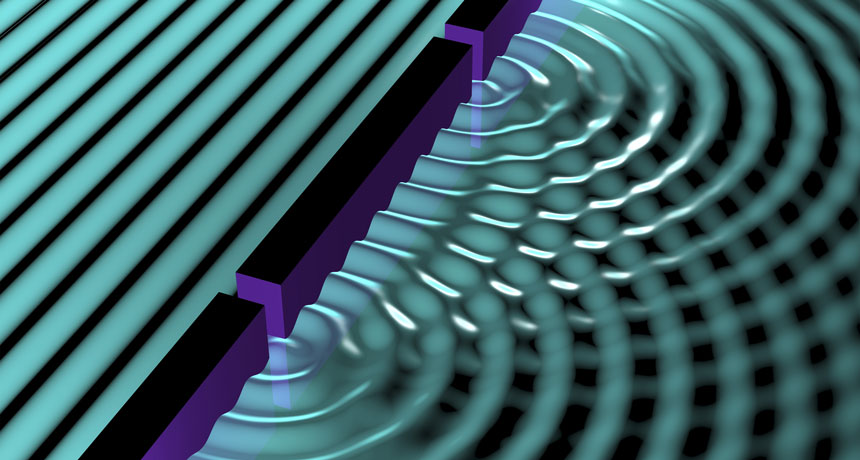
Young’s experiment.
Twentieth-century physicists went on to use Young’s experiment with other individual quantum particles, and held it up as proof that quantum physics had Through-the-Looking-Glass properties: quant um entities acted wavelike and travelled though both slits at once. Fire a stream of electrons at the triple screens, and you end up with the interference patterns of alternating light and dark patches, just as you do with a beam of light. Since you need at least two waves to create such interference patterns, the implication of the experiment is that the photon is somehow mysteriously able to travel through both slits at the same time and interfere with itself when it reunites.
The double-slit experiment encapsulates the central mystery of quantum physics
- the idea that a subatomic particle is not a single seat but the entire stadium. It also demonstrates the principle that electrons, which exist in a hermetic quantum state, are ultimately unknowable. You could not identify something about a quantum entity without stopping the particle in its tracks, at which point it would collapse to a single point.
In Zeilinger’s adaptation of the slit experiment, using molecules instead of subatomic particles, the interferometer contained an array of slits in the first screen, and a grating of identical parallel slits in the second one, whose purpose was to diffract (or deflect) the molecules passing by. The third grating, turned perpendicular to the beam of molecules, acted as a scanning ‘mask’, with the ability to calculate the size of the waves of any of the molecules passing through, by means of a highly sensitive laser detector to locate the positions of the molecules and their interference patterns.
For the initial experiment, Zeilinger and his team carefully chose a batch of fullerene molecules, or ‘buckyballs’ made of 60 carbon atoms. At one nanometre apiece, these are the behemoths of the molecular world. They selected fullerene not only for its size but also for its neat arrangement, with a shape like a tiny symmetrical football.
It was a delicate operation. Zeilinger’s group had to work with just the right temperature; heating the molecules just a hair too much would cause them to disintegrate. Zeilinger heated the fullerenes to 900 K so they would create an intense molecular beam, then fired them through the first screen; they then passed through the second screen before making a pattern on the final screen. The results were unequivocal. Each molecule displayed the ability to create interference patterns with itself. Some of the largest units of physical matter had not ‘localized’ into their final state. Like a subatomic particle, these giant molecules had not yet gelled into anything real.
The Vienna team scouted out some other molecules that were double the size and oddly shaped to see if geometrically asymmetric molecules also demonstrated the same magical properties. They settled on gigantic fluorinated American football- shaped molecules of 70 carbon atoms and pancake-shaped tetraphenylporphyrin, a derivative of the biodye present in chlorophyll. At more than 100 atoms apiece, both of these entities are among the largest molecules on the planet. Again, each one created an interference pattern with itself.
Zeilinger’s group repeatedly demonstrated that the molecules could be two places at once, which meant that they remained in a state of superposition even at this large scale.[25]
They had proved the unthinkable: the largest components of physical matter and living things exist in a malleable state.[26]
Sai Ghosh didn’t often think about the implications of her discovery.
She was content with the knowledge that her experiment had made a very nice paper, and might help along her career as an assistant professor involved in research into miniaturization, the direction she believed quantum mechanics was heading. Occasionally, she allowed herself to speculate that her crystal might have proved something important about the nature of the universe. But she was only a postgraduate student. What did she, after all, really know about how the world worked?
But to me, Ghosh’s research and Zeilinger’s work on the double-slit experiment represent two defining moments in modern physics. Ghosh’s experiments show that an invisible connection exists between the fundamental elements of matter, which is often so strong that it can override classical methods of influence, such as heat or a push. Zeilinger’s work demonstrated something even more astonishing. Large matter was neither something solid and stable nor something that necessarily behaved according to Newtonian rules. Molecules needed some other influence to settle them into a completed state of being.
Theirs were the first evidence that the peculiar properties of quantum physics do not simply occur at the quantum level with subatomic particles, but also in the world of visible matter. Molecules also exist in a state of pure potential, not a final actuality. Under certain circumstances, they escape Newtonian rules of force and display quantum non-local effects. The fact that something as large as a molecule can become entangled suggests that there are not two rule books – the physics of the large and the physics of the small – but only a single rule book for all of life.
These two experiments also hold the key to a science of intention – how thoughts are able to affect finished, solid matter.
Thoughts create reality. They can change the physical world around us in the most profound manners. Thus we absolutely need to have direct and substantive control over our thoughts.
They suggest that the observer effect occurs not simply in the world of the quantum particle but also in the world of the everyday. Things no longer should be seen to exist in and of themselves but, like a quantum particle, only in relationship. Co-creation and influence may be a basic, inherent property of life.
Our observation of every component in our world may help to determine its final state, which suggests that we are likely to be influencing every large thing we see around us.
When we enter a crowded room, when we engage with our partners and our children, when we gaze up at the sky, we may be creating and even influencing at every moment. We can’t yet demonstrate this at normal temperatures; our equipment is still too crude. But we already have some preliminary proof: the physical world – matter itself – appears to be malleable, susceptible to influence from the outside.
Notes – Chapter 1: Mutable Matter
- All personal information about Tom Rosenbaum and Sai Ghosh and their studies have been culled from multiple interviews conducted in February and March 2005.
- This was the solution posed by Giorgio Parisi at Rome in 1979.
- S. Ghosh et al., ‘Coherent spin oscillations in a disordered magnet’, Science, 2002; 296: 2195–8.
- Once again, I am indebted to Danah Zohar for her easy-to-digest description of quantum non-locality, which appears in D. Zohar, The Quantum Self, London: Bloomsbury, 1991: 19–20.
- A. Einstein, B. Podolsky and N. Rosen, ‘Can quantum-mechanica description of physical reality be considered complete?’ Physical Review, 1935; 47: 777–80.
- A. Aspect et al., ‘Experimental tests of Bell’s inequalities using time- varying analyzers’, Physical Review Letters, 1982; 49: 1804–7; A. Aspect, ‘Bell’s inequality test: more ideal than ever’, Nature, 1999; 398: 189–90.
- Science Fact: Scientists achieve ‘Star Trek’-like feat – The Associate Press, December 10, 1997, posted on CNN http://edition.cnn.com/TECH/9712/10/beam. me. up. ap.
- Non-locality was considered to be proven by Aspect et al.’ s experiments in Paris in 1982.
- J. S. Bell, ‘On the Einstein-Poldolsky-Rosen paradox’,Physics, 1964; 1: 195–200.
- S. Ghosh et al., ‘Entangled quantum state of magnetic dipoles’, Nature, 2003; 435: 48–51.
- Details of Vedral’s views and experiments the result of multiple interviews, February, October and December 2005.
- C. Arnesen et al., ‘Thermal and magnetic entanglement in the 1D Heisenberg Model’, Physical Review Letters, 2001; 87: 017901.
- V. Vedral, ‘Entanglement hits the big time’, Nature, 2003; 425: 28–9.
- T. Durt, interview with author, April 26, 2005.
- B. Reznik, ‘Entanglement from the vacuum’, Foundations of Physics, 2003; 33: 167–76; Michael Brooks, ‘Entanglement: The weirdest link’, New Scientist, 2004; 181 (2440): 32.
- John D. Barrow, The Book of Nothing, London: Jonathan Cape, 2000: 216.
- Erwin Laszlo, The Interconnected Universe: Conceptual Foundations o Transdiscipinary Unified Theory, Singapore: World Scientific Publishing, 1995: 28.
- A. C. Clarke, ‘When will the real space age begin?’ Ad Astra, May–June 1996; 13–15.
- Harold Puthoff, ‘Ground state of hydrogen as a zero-point-fluctuation- determined state’, Physical Review D, 1987; 35: 3266.
- B. Haisch, Alfonso Rueda and H. E. Puthoff, ‘Inertia as a zero-point-fiel Lorentz force’, Physical Review A, 1994; 49 (2): 678–94; Bernhard Haisch, Alfonso Rueda and H. E. Puthoff, ‘Physics of the zero-point field implications for inertia, gravitation and mass’, Speculations in Science and Technology, 1997; 20: 99–114.
- Reznik, ‘Entanglement from the vacuum’, op. cit.
- McTaggart, The Field, op. cit.: 35–6.
- J. Resch et al., ‘Distributing entanglement and single photons through an intra-city, free-space quantum channel’, Optics Express, 2005; 13 (1): 202–9; R. Ursin et al., ‘Quantum teleportation across the Danube’, Nature, 2004; 430: 849.
- M. Arndt et al., ‘Wave–particle duality of C60 molecules’, Nature, 1999; 401: 680–2; doi: 10.1038/44348.
- A. Zeilinger, ‘Probing the limits of the quantum world’, Physics World, March 2005 (online journal: http://www.physicsweb.org/articles/world/18/3/5/1).
CHAPTER TWO
The Human Antenna
IN 1951, AT THE AGE OF SEVEN, Gary Schwartz made a remarkabe discovery. He had been trying to get a good picture on the family’s television set. The recently acquired black and white Magnavox set encased behind the doors of its boxed walnut console fascinated him, not because of the people in the moving pictures so much as the means by which they arrived in his living room in the first place.
The mechanisms of the relatively new invention remained a mystery, even to most adults. Television, like any other electrical gadget, was something the precocious child longed to take apart and understand. This passion had already found expression with the worn-out radios given to him by his grandfather.
Ignatz Schwartz sold replacement tubes for televisions and radios in his drug store in Great Neck, Long Island, and those that were beyond repair were handed over to his grandson to disassemble. In a corner of Gary’s bedroom lay a mass of experimental debris – tubes, resistors and the carcasses of radios heaped on the cosmetic display racks he had borrowed from his grandfather – the first signs of what would become a lifelong fascination with electronics.
Gary knew that the way you twisted the rabbit-ear antenna on top of the television would determine the clarity of the picture. His father had explained that television sets were powered by something invisible, similar to radio waves, that flew through the air and were somehow translated into an image.
Gary had even carried out some rudimentary experiments. When you stood somewhere between the antenna and the television, you could make the picture go away. When you touched the antenna in certain ways, you made the picture clearer.
One day, on a whim, Gary unscrewed the antenna and placed his finger on the screw where the cable had been. What had been a mass of squiggles and static noise on the screen suddenly coalesced into a perfect image.
Even at that young age, he had understood that he had witnessed something extraordinary about human beings: his body was acting like a television antenna, a receiver of this invisible information.
He tried the same experiment with a radio – substituting his finger for the antenna, and the same thing happened.
Something in the makeup of a person was not unlike the rabbit ears that helped produce his television image. He too was a receiver of invisible information, with the ability to pick up signals transmitted across time and space.
Until he was 15, however, he could not visualize what these signals were made of. He had learned to play the electric guitar and had often wondered what unseen influences allowed the instrument to create different sounds. He could play the same note, middle C, and yet produce more of a treble or bass sound, depending on which way he turned the knob. How was it possible that a single note could sound so different? For a science project, he created multiple-track recordings of his music and then located a company in upstate New York that had equipment designed to analyse the frequency of sound. When he fed his recordings into the equipment, it quickly deconstructed the notes down to their essence.
Each note registered as a batch of squiggles across the screen of the cathode-ray tube in front of him – a complex mix of hundreds of frequencies representing a blend of overtones that would subtly change when he turned the knob to treble or bass. He knew that these frequencies were waves, represented on the monitor as a sideways S, or sine curve, like a skipping rope held at both ends and wriggled, and that they had periodic oscillations, or fluctuations, similar to the waves on Long Island Sound.
Every time he spoke, he knew he generated similar frequencies through his voice. He remembered his early television experiments and wondered whether a field of energy pulsated inside him and shared a kinship with sound waves.1
Gary’s childhood experiments may have been rudimentary, but he had already stumbled across the central mechanism of intention. Something in the quality of our thoughts was a constant transmission, not unlike a television station.
As an adult, Schwartz, still a bustling dynamo of enthusiasms, found an outlet in psychophysiology, then a fledgling study of the effect of the mind on the body.
By the time he had accepted a post at the University of Arizona, which was known for encouraging freedom of research among its faculty, he had grown fascinated by biofeedback and the ways in which the mind could control blood pressure and a variety of illnesses – and the powerful physical effect of different types of thoughts.2
One weekend in 1994, at a conference on the relationship between love and energy, he sat in on a lecture by physicist Elmer Green, one of the pioneers of biofeedback. Green, like Schwartz, had grown interested in the energy being transmitted by the mind.
To examine this more closely, he had decided to study remote healers and to determine whether they sent out more electrical energy than usual while in the process of healing.
Green reported in his lecture that he had built a room whose four walls and ceiling were entirely made of copper, and were attached to microvolt electroencephalogram (EEG) amplifiers – the kind used to measure the electrical activity in the brain.
Ordinarily, an EEG amplifier is attached to a cap with imbedded electrodes, each of which records separate electrical discharges from different places in the brain. The cap is placed on a person’s head, and the electrical activity picked up is displayed on the amplifier.
EEG amplifiers are extraordinarily sensitive, capable of picking up the most minute of effects – even one-millionth of a volt of electricity.
In remote healing, Green suspected that the signal produced was electrical and emanated from the healer’s hands. The copper wall acted like a giant antenna, magnifying the ability to detect the electricity from the healers and enabling Green to capture it from five directions.
He discovered that, whenever a healer sent healing, the EEG amplifier often recorded it as a huge surge of electrostatic charge, the same kind of the build up and discharge of electrons that occurs after you shuffle your feet along a new carpet and then touch a metal doorknob.3
In the early days of the copper wall experiment, Green had been faced with an enormous problem. Whenever a healer so much as wriggled a finger, patterns got recorded on an EEG amplifier.
Green had had to work out a means of separating out the true effects of healing from this electrostatic noise. The only way to do so, as he saw it, was to have his healers remain perfectly still while they were sending out healing energy.
Schwartz listened to the talk with growing fascination. Green was discarding what might be the most interesting part of the data, he thought. One man’s noise was another man’s signal.
Does movement, even the physiology of your breathing, create an electromagnetic signal big enough to be picked up on a copper wall? Could it be that human beings were not only receivers of signals but also transmitters?
It made perfect sense that we transmitted energy. A great deal of evidence had already proved that all living tissue has an electric charge. Placing this charge in three-dimensional space caused an electromagnetic field that traveled at the speed of light. The mechanisms for the transmission of energy were clear, but what was unclear was the degree to which we sent out electromagnetic fields just by simple movements and whether our energy was being picked up by other living things.
Schwartz was itching to test this out for himself. After the conference, he contacted Green for advice about how to build his own copper wall. He rushed to Home Depot, which did not stock copper shielding but did have aluminum shielding, which could also act as a rudimentary antenna.
He purchased some two by fours, placed them on glass bricks so that they would be isolated from the ground, and used them to assemble a ‘wall’. After he had attached the wall to an EEG amplifier, he began playing around with the effects of his hand, waving it back and forth above the box. As he suspected, the amplifier tracked the movement. His hand movements were generating signals.4
Schwartz began demonstrating these effects in front of his students in his faculty office, making use of a bust of Einstein for dramatic effect. With these experiments, he made use of an EEG cap, with its dozens of electrodes. When not picking up brain signals, the cap will register only noise on the amplifier.
During his experiments, Schwartz placed the EEG cap on his Einstein bust, an turned on just a single electrode channel on the top of the cap. Then he moved his hand over Einstein’s head. As though the great man had suddenly experienced a moment of enlightenment, the amplifier suddenly came alive and produced evidence of an electromagnetic wave.
But the signal, Schwartz explained to his students, was not a sudden brain wave emitted from the lifeless statue – only the tracking of the electromagnetic field produced by his arm’s movement. It seemed indisputable: his body must be sending out a signal with every single flutter of his hand.
Schwartz got more creative with his experiments. When he tried the same gesture from three feet away, the signal diminished. When he placed the bust in a Faraday cage, an enclosure of tightly knit copper mesh that screens out electromagnetic fields, all effect disappeared. This strange energy resulting from movement had all the hallmarks of electricity: it decreased with distance, and was blocked by an electromagnetic shield.
At one point, Schwartz asked one of the students to stand with his left hand over Einstein’s head, with his right arm extended towards Schwartz, who was sitting in a chair three feet away. Schwartz moved his arm up and down. To the amazement of the other students, Schwartz’s movement was picked up by the amplifier. The signal had passed through Schwartz’s body and travelled through the student. Schwartz was still generating the signal, but this time, the student had become the antenna, receiving the signal and transmitting it to the amplifier, which acted as another antenna.
Schwartz realized he had hit upon the most important point of all his research.
Simple movement generated electrical charge, but, more important, it created a relationship. Every movement we make appears to be felt by the people around us.
The implications were staggering.
What if he were admonishing a student? What might be the physical effect on the student of wagging his finger while shouting ‘Don’t do that’? The student might feel as if he were getting shot with a wave of energy.
Some people might even have more powerful positive or negative charges than others. In Elmer Green’s copper wall experiment, all sorts of equipment malfunctioned in the presence of Roslyn Bruyere, a famous healer.
Schwartz was onto something fundamental about the actual energy that human beings emit. Could the energy of thought have the same effect as the energy of movement outside the thinker’s own body? Did thoughts also create a relationship with the people around us?
Every intention towards someone else might have its own physical counterpart, which would be registered by its recipient as a physical effect.
Like Schwartz, I suspected the energy generated by thoughts did not behave in the same way as the energy generated by movement. After all, the signal from movement decreased over distance, much like ordinary electricity. With healing, distance appeared to be irrelevant.
The energy of intention, if indeed there were any, would have to be more fundamental than that of ordinary electromagnetism – and lie somewhere, perhaps, in the realm of quantum physics. How could I test the energetic effects of intention?
Healers, who appeared to be sending more energy than normal through their healing, offered an obvious place to start.
Elmer Green demonstrated in his research that an enormous surge of electrostatic energy occurred during healing.
When a person is simply standing still, his or her breathing and beating heart will produce electrostatic energy of 10–15 millivolts on the EEG amplifiers; during activities requiring focused attention, such as meditation, the energy will surge up to 3 volts.
During healing, however, Green’s healers produced voltage surges up to 190 volts; one produced 15 such pulses, which were 100,000 times higher than normal, with smaller pulses of 1–5 volts appearing on each of the four copper walls.
On investigating the source of this energy, Green discovered that the pulses were coming from the healer’s abdomen, called dan tien and considered the central engine of internal energy in the body in Chinese martial arts.5
Stanford University physicist William Tiller constructed an ingenious device to measure the energy produced by healers. The equipment discharged a steady stream of gas and recorded the exact number of electrons pulsing out with the discharge.
Any increase in voltage would be captured by the pulse counter.
In his experiment, Tiller asked ordinary volunteers to place their hands about six inches from his device and hold a mental intention to increase the count rate.
In the majority of more than 1000 such experiments, Tiller discovered that, during the intention, the number of recorded pulses would increase by 50,000 and remain there for 5 minutes.
These increases would occur even if a participant was not close to the machine, so long as he or she held an intention.
Tiller concluded that directed thoughts produce demonstrable physical energy, even over remote distance.6
Tiller concluded that directed thoughts produce demonstrable physical energy, even over remote distance..
I found two other studies measuring the actual electrical frequencies emitted by people using intention.
One study measured healing energy and the other examined energy generated by a Chinese Qigong master during times that he was emitting external Qi, the Chinese term for energy or the life force.7
In both instances, the measurements were identical: frequency levels of 2–30 hertz were being emitted by the healers.
This energy also seemed to change the molecular nature of matter.
Qi seemed to change the molecular nature of matter.
I discovered a body of scientific evidence examining chemical changes caused by intention.
Bernard Grad, an associate professor of biology at McGill University in Montreal had examined the effect of healing energy on water that was to be used to irrigate plants.
After a group of healers had sent healing to samples of water, Grad chemically analysed the water by infrared spectroscopy.
He discovered that the water treated by the healers had undergone a fundamental change in the bonding of oxygen and hydrogen in its molecular makeup.
The hydrogen bonding between the molecules had lessened in a similar manner to that which occurs in water exposed to magnets.8
A number of other scientists confirmed Grad’s findings; Russian research discovered that the hydrogen–oxygen bonds in water molecules undergo distortions in the crystalline microstructure during healing.9
These kinds of changes can occur simply through the act of intention.
In one study, experienced meditators sent an intention to affect the molecular structure of water samples they were holding throughout the meditation.
When the water was later examined by infrared spectrophotometry, many of its essential qualities, particularly its absorbance – the amount of light absorbed by the water at a particular wavelength had been significantly altered.10
When someone holds a focused thought, he may be altering the very molecular structure of the object of his intention.
When someone holds a focused thought, he may be altering the very molecular structure of the object of his intention.
In his research, Gary Schwartz wondered whether intention only manifested as electrostatic energy. Perhaps magnetic energy also played a role.
Magnetic fields naturally had more power, more ‘push–pull’ energy. Magnetism seemed the more powerful and universal energy; the earth itself is profoundly influenced by its own faint pulse of geomagnetic energy.
Schwartz remembered a study carried out by William Tiller, in which psychics had been placed inside a variety of devices that block different forms of energy.
They had performed better than usual in a Faraday cage, which filters out only electrical energy, but they performed worse when placed in a magnetically shielded room.11
From these early studies, Schwartz gleaned two important implications: healing may generate an initial surge of electricity, but the real transfer mechanism may be magnetic.
Indeed, psychic phenomena and psychokinesis could be differentially influenced, simply through different types of shielding. Electrical signals might interfere, while magnetic signals enhance the process.
To test this latest idea, Schwartz was approached by a colleague of his, Melinda Connor, a post-doctoral fellow in her mid-forties with an interest in healing.
The first hurdle was finding an accurate means of picking up magnetic signals. Measuring tiny low-frequency magnetic fields is tricky, requiring the use of expensive and highly sensitive equipment called a SQUID, or superconducting quantum interferenc device.
A SQUID, which can cost up to four million dollars, ordinarily occupies a specially constructed room that has been magnetically shielded in order to eliminate ambient radiating noise.
The best Schwartz and Connor could come up with on their limited budget was a poor man’s SQUID – a small handheld, battery-operated three-axis digita gaussmeter originally designed to measure electromagnetic pollution by picking up extra-low-frequency (ELF) magnetic fields.
The gaussmeter was sensitive enough to pick up one-thousandth of a gauss, a very faint pulse of a magnetic field. In Schwartz’s mind, this level of sensitivity was more than adequate to do the job.
It occurred to Connor that the way to measure change in low-frequency magnetic fields was to count the number of changes in the meter reading over time. When simply recording ambient stable magnetic fields, the device will only deviate slightly by less than one-tenth of a gauss.
However, in the presence of an oscillating magnetic field – with periodic changes in frequency – the numbers will keep moving, from, say, 0.6 to 0.7 to 0.8, and back down to 0.6.
The greater and more frequent the change, which would be recorded by the number of changes in the dials, the more likely it is that the magnetic field has been affected by a source of directed energy.
Connor and Schwartz gathered together a group of practitioners of Reiki, the healing art developed a century ago in Japan.
They took measurements near each hand of all the healers during alternating periods while they were ‘running energy’ and then during times they were at rest, with their eyes closed.
Next, the pair assembled a group of ‘master healers’ with a substantial track record of successful, dramatic healings.
Again, Connor and Schwartz took magnetic field measurements near each hand, while the master healers were running energy and at rest. Then, they compared the Reiki measurements with measurements they had taken of people who had not been trained in healing.
Once Schwartz and Conner had analyzed the data, they discovered that both groups of healers demonstrated significant fluctuations in very low pulsations of a magnetic field, emanating from both hands.
A huge increase in oscillations in the magnetic field occurred whenever a healer began to run energy. However, the most profound energy increase surged from their dominant hands. The control group of people who were not trained healers did not demonstrate the same effect.
Then Schwartz compared effects from the Reiki group with those of the master healers and discovered another enormous difference. The master healers averaged close to a third more magnetic-field changes per minute than the Reiki healers.12
The study results seemed clear. Schwartz and Connor had their proof that directed intention manifests as both electrostatic and magnetic energy.
Directed intention manifests as both electrostatic and magnetic energy.
But they also discovered that intention was like playing the piano; you need to learn how to do it, and some people do it better than others.
The ability to manipulate energy comes with training and practice.
In considering what this all meant, Gary Schwartz thought of the phrase often used by medical doctors, usually in emergency situations: when you hear hoof beats, don’t think zebras .
In other words, when you are trying to diagnose someone with physical symptoms, first rule out all the most likely causes, and only then consider more exotic possibilities.
He liked to approach science in the same way and so he questioned his own findings: Could the healers’ increase in magnetic field oscillations during healing simply be the result of certain peripheral biophysical changes?
Muscle contractions generate a magnetic field, as do changes in blood flow, the increasing or decreasing dilation of blood vessels, the body’s current volume of liquid or even the flow of electrolytes.
Skin, sweat glands, change of temperature, neural induction – all generate magnetic fields.
His guess was that healing resulted from a summation of multiple biological processes that are mediated magnetically.
But the possibility that healing might be a magnetic effect did not explain long- distance remote healing.
In some instances, healers sent healing from thousands of miles away and the effect did not decay with distance.
In one successful study of AIDS patients who improved through remote healing, the 40 healers involved in the study sent the healing to the San Francisco patients from locations all across America.13
Similar to electrical fields, magnetic fields decrease with distance. The magnetic and electrical effects were likely to be some aspect of the process, but not its central one. It was likely to be closer to a quantum field, possibly more akin to light.
Schwartz began to consider the possibility that the mechanism creating intention originated with the tiny elements of light emitted from human beings.
In the mid- 1970s, a German physicist named Fritz-Albert Popp had stumbled upon the fact that all living things, from the most basic of single-celled plants to the most sophisticated of organisms like human beings, emitted a constant tiny current of photons – tiny particles of light.14
He labelled them ‘biophoton emissions’ and believed that he had uncovered the primary communication channel of a living organism – that it used light as a means of signalling to itself and to the outside world.
For more than 30 years, Popp has maintained that this faint radiation, rather than biochemistry, is the true driving force in orchestrating and coordinating all cellular processes in the body.
Light waves offered a perfect communication system able to transfer information almost instantaneously across an organism.
Having waves, rather than chemicals, as the communication mechanism of a living being also solved the central problem of genetics – how we grow and take final shape from a single cell.
It also explains how our bodies manage to carry out tasks with different body parts simultaneously. Popp theorized that this light must be like a master tuning fork setting off certain frequencies that would be followed by other molecules of the body.15
A number of biologists, such as the German biophysicist Herbert Fröhlich, had proposed that a type of collective vibration causes proteins and cells to coordinate their activities.
Nevertheless, all such theories were ignored until Popp’s discoveries, largely because no equipment was sensitive enough to prove they were right.
With the help of one of his students, Popp constructed the first such machine – a photomultiplier that captured light and counted it, photon by photon. He carried out years of impeccable experimentation that demonstrated that these tiny frequencies were mainly stored and emitted from the DNA of cells.
The intensity of the light in organisms was stable, ranging from a few to several hundred photons per second per square centimetre surface of the living thing – until the organism was somehow disturbed or ill, at which point the current went sharply up or down.
The signals contained valuable information about the state of the body’s health and the effects of any particular therapy. Cancer victims had fewer photons, for instance. It was almost as though their light were going out.
Initially vilified for his theory, Popp was eventually recognized by the German government and then internationally.
Eventually he formed the International Institute of Biophysics (IIB), composed of 15 groups of scientists from international centres all around the world, including prestigious institutions like CERN in Switzerland Northeastern University in the USA, the Institute of Biophysics Academy of Scienc in Beijing, China, and Moscow State University in Russia. By the early twenty-firs century, the IIB numbered at least 40 distinguished scientists from around the globe.
Could it be that these were the frequencies that mediated healing? Schwartz realized that if he was going to carry out studies of biophoton emissions, first he had to figure out how to view these tiny emissions of light.
In his laboratory, Popp developed a computerized mechanism attached to a box in which a living thing, such as a plant, could be placed. The machine could count the photons and chart the amount of light emitted on a graph. But those machines only recorded photons in utter pitch blackness. Up until then, it had been impossible for scientists to witness living things actually glowing in the dark.
As Schwartz mulled over the kind of equipment that would allow him to see very faint light, he thought of state-of-the-art supercooled charge-coupled device (CCD) cameras on telescopes. This exquisitely sensitive equipment, now used to photograph galaxies deep in space, picks up about 70 per cent of any light, no matter how faint.
CCD devices were also used for night-vision equipment.
If a CCD camera could pick up the light from the most distant of stars, it might also be able to pick up the faint light coming off living things.
However, this kind of equipment can cost hundreds of thousands of dollars and usually had to be cooled to temperatures only 100 degrees above absolute zero, to eliminate any ambient radiation emitted at room temperature.
Cooling the camera down also helped to improve its sensitivity to faint light. Where on earth was he going to get hold of this kind of high-tech equipment?
Kathy Creath, a professor of optical sciences at Schwartz’s university, who shared his fascination with living light and its possible role in healing, had an idea.
As it happened, she knew that the department of radiology at the National Science Foundation (NSF) in Tucson owned a low-light CCD camera, which they used t measure the light emitted from laboratory rats after being injected with phosphorescent dyes.
The Roper Scientific VersArray 1300 B low-noise, high performance CCD camera was housed in a dark room inside a black box and above a Cryotiger cooling system, which cooled temperatures to –100°C. A computer screen displayed its images. It was just what they were looking for.
After Creath approached the director of the NSF project, he generously agreed to allow the two of them access to the camera during its down time.
In their first test, Schwartz and Creath placed a geranium leaf on a black platform. They took fluorescent photographs after exposures of up to five hours.
When the computer displayed the final photograph, it was dazzling: a perfect image of the leaf in light, like a shadow in reverse, but in incredible detail, each of its tiniest veins delineated.
Surrounding the leaf were little white spots, like a sprinkling of fairy dust – evidence of high-energy cosmic rays. With his next exposure, Schwartz used a software filter to screen out the ambient radiation. The image of the leaf was now perfect.
As they studied this latest photograph on the screen of the computer in front of them, Schwartz and Creath understood that they were making history. It was the first time a scientist had been able to witness images of the light actually emanating from a living thing.16
Now that he had equipment that captured and recorded light, Schwartz was finally able to test whether healing intention also generated light.
Creath got hold of a number of healers, and asked them to place their hands on the platform underneath the camera for 10 minutes. Schwartz’s first crude images showed a rough glow of large pixilations, but they were too out of focus for him to analyse them.
Next he tried placing the healers’ hands on a white background (which reflected light) rather than on a black background (which absorbed light).
The images were breathtakingly clear: a stream of light flowed out of the healers’ dominant hands, almost as though it were flowing from their fingers.
Schwartz now had his answer about the nature of conscious thought: healing intention creates waves of light – and, indeed, among the most organized light waves found in nature.
The theory of relativity was not Einstein’s only great insight.
He had had another astonishing realization in 1924, after correspondence with an obscure Indian physicist, Satyendra Nath Bose, who had been pondering the then-new idea that light was composed of little vibrating packets called photons.
Bose had worked out that, at certain points, photons should be treated as identical particles. At the time nobody believed him – nobody but Einstein, after Bose sent him his calculations.
Einstein liked Bose’s proofs and used his influence to get Bose’s theory published.
Einstein also was inspired to explore whether, under certain conditions or certain temperatures, atoms in a gas, which ordinarily vibrated anarchically, might also begin to behave in synchrony, like Bose’s photons.
Einstein set to work on his own formula to determine which conditions might create such a phenomenon.
When he reviewed his figures, he thought he had made a mistake in his calculations.
According to his results, at certain extraordinarily low temperatures, just a few kelvin above absolute zero, something really strange would begin to happen: the atoms, which ordinarily can operate at a number of different speeds, would slow down to identical energy levels.
In this state, the atoms would lose their individuality and both look and behave like one giant atom. Nothing in his mathematical armamentarium could tell them apart.
If this were true, he realized, he had stumbled upon an entirely new state of matter, with utterly different properties from anything known in the universe.
Einstein published his findings,17 and lent his name to the phenomenon, called a Bose–Einstein condensate, but he was never convinced that he had been right.
Nor were other physicists, until more than 70 years later when, on 5 June 1995, Eric Cornell and Carl Wieman of JILA, a programme sponsored by the National Institut of Standards and Technology and the University of Colorado at Boulder, managed to cool a tiny batch of rubidium atoms down to 170 billionths of a degree above absolute zero.18
It had been quite a feat, requiring trapping the atoms in a web of laser light and then magnetic fields.
At a certain point, a batch of some 2000 atoms – measuring about 20 microns, about one-fifth the thickness of a single piece of paper – began behaving differently from the cloud of atoms surrounding them, like one smeared-out single entity.
Although the atoms were still part of a gas, they were behaving more like the atoms of a solid.
Four months later, Wolfgang Ketterle from Massachusetts Institute of Technology replicated their experiment, but with a form of sodium, for which he, as well as Cornell and Wieman, won the 2001 Nobel prize.19
Then a few years after that, Ketterle and others like him were able to reproduce the effect with molecules.20
Scientists believed that a form of Einstein and Bose’s theory could account for some of the strange properties they had begun to observe in the subatomic world: superfluidity, when certain fluids can flow without losing energy, or even spontaneously work themselves out of their containers; or superconduction, a similar property of electrons in a circuit.
In superfluid or superconductor states, liquid or electricity could theoretically flow at the same pace forever.
Ketterle had discovered another amazing property of atoms or molecules in this state. All the atoms were oscillating in perfect harmony, similar to photons in a laser, which behave like one giant photon, vibrating in perfect rhythm.
This organization makes for an extraordinary efficiency of energy. Instead of sending a light about 3 meters, the laser emits a wave 300 million times that far.
Scientists were convinced that a Bose–Einstein condensate was a peculiar property of atoms and molecules slowing down so much that they are almost at rest, when exposed to temperatures only a fraction above the coldest temperatures in the universe.
But then Fritz-Albert Popp and the scientists working with him made the astonishing discovery that a similar property existed in the weak light emanating from organisms. This was not supposed to happen in the boiling inner world of the living thing.
What is more, the biophotons he measured from plants, animals and humans were highly coherent. They acted like a single super-powerful frequency, a phenomenon also referred to as ‘superradiance’.
The German biophysicist Herbert Fröhlich had first described a model in which this type of order could be present and play a central role in biological systems. His model showed that, with complex dynamic systems like human beings, the energy within created all sorts of subtle relationships, so that it is no longer discordant.21
Living energy is able to organize to one giant coherent state, with the highest form of quantum order known to nature.
When subatomic particles are said to be ‘coherent’, or ‘ordered’, they become highly interlinked by bands of common electromagnetic fields, and resonate like a multitude of tuning forks all attuned to the same frequency.
They stop behaving like anarchic individuals and begin operating like one well- rehearsed marching band.
As one scientist put it, coherence is like comparing the photons of a single 60- watt light bulb to the sun.
Ordinarily, light is extraordinarily inefficient. The intensity of light from a bulb is only about 1 watt per square centimetre of light – because many of the waves made by the photons destructively interfere with and cancel out each other.
The light per square centimetre generated by the sun is about 6000 times stronger.
But if you could get all the photons of this one small light bulb to become coherent and resonate in harmony with each other, the energy density of the single light bulb would be thousands to millions of times higher than that of the surface of the sun.22
After Popp made his discoveries about coherent light in living organisms, other scientists postulated that mental processes also create Bose–Einstein condensates.
British physicist Roger Penrose and his partner, American anaesthetist Stuar Hameroff from the University of Arizona, were in the vanguard of frontier scientists who proposed that the microtubules in cells, which create the basic structure of the cells, were ‘light pipes’ through which disordered wave signals were transformed into highly coherent photons and pulsed through the rest of the body.23
Gary Schwartz had witnessed just this coherent photon stream emanating from the hands of healers.
After studying the work of scientists like Popp and Hameroff, he finally had his answer about the source of healing: if thoughts are generated as frequencies, healing intention is well-ordered light.
Gary Schwartz’s creative experiments revealed to me something fundamental about the quantum nature of thoughts and intentions. He and his colleagues had uncovered evidence that human beings are both receivers and transmitters of quantum signals.
Directed intention appears to manifest as both electrical and magnetic energy and to produce an ordered stream of photons, visible and measurable by sensitive equipment.
Perhaps our intentions also operate as highly coherent frequencies, changing the very molecular makeup and bonding of matter.
Like any other form of coherence in the subatomic world, one well-directed thought might be like a laser light, illuminating without ever losing its power.
I was reminded of an extraordinary experience Schwartz once had in Vancouver. He had been staying in the penthouse apartment suite of a downtown hotel.
He had awakened at 2 a.m., as he often did, and had walked out to the balcony to have a look at the spectacular view of the city to the west, framed by the mountains. He was surprised to see how many hundreds of homes along the peninsula below him still had their lights on.
He wished he had a telescope handy to see what some of the people were doing up at this late hour. But of course, if any of them had their own telescope, they would be able to see him standing there in the nude.
An odd thought suddenly came to him of his own naked image flying into each window. But maybe the idea was not so fanciful.
After all, he was emitting a constant stream of biophotons, all travelling at the speed of light; each photon would have travelled 186,000 miles one second later, and 372,000 miles one second after that.
His light was not unlike the photons of visible light emanating from stars in the sky. Much of the light from distant stars has been traveling for millions of years. Starlight contains a star’s individual history.
Even if a star had died long before its light reached earth, its information remains, an indelible footprint in the sky.
He then had a sudden image of himself as a ball of energy fields, a little star, glowing with a steady stream of every photon his body had ever produced for more than 50 years.
All the information he had been sending from the time he was a young boy in Long Island, every last thought he had ever had, was still out there, glowing like starlight. Perhaps, I thought, intention was also like a star.
Once constructed, a thought radiated out like starlight, affecting everything in its path.
Notes – Chapter 2: The Human Antenna
- All personal details about Gary Schwartz and his discoveries result from multiple interviews with him and the author, March–June 2006.
- H. Benson et al., ‘Decreased systolic blood pressure through operant conditioning techniques in patients with essential hypertension’, Science, 1971; 173 (3998): 740–2.
- E. E.
Green, ‘Copper wall research psychology and psychophysics: subtle energies and energy medicine: emerging theory and practice’, Proceedings, First Annual Conference, International Society for the Stud of Subtle Energies and Energy Medicine (ISSSEEM,) Boulder, Colorado, 21–25 June 1991. - This research was eventually published as G. Schwartz and L.
Russek ‘Subtle energies – electrostatic body motion registration and the human antenna-receiver effect: a new method for investigating interpersonal dynamical energy system interactions’, Subtle Energies and Energy Medicine, 1996; 7 (2): 149–84. - E. E. Green et al., ‘Anomalous electrostatic phenomena in exceptional subjects’, Subtle Energies and Energy Medicine, 1993; 2: 69; W. A.
Tiller et al., ‘Towards explaining anomalously large body voltage surges on exceptional subjects, Part I: The electrostatic approximation’, Journal of Scientific Exploration, 1995; 9 (3): 331. - William A. Tiller, ‘Subtle energies’, Science & Medicine, 1999, 6 (3): 28–33.
- A. Seto et al., ‘Detection of extraordinary large biomagnetic field strength from the human hand during external qi emission’, Acupuncture and Electrotherapeutics Research International, 1992; 17: 75–94; J.
Zimmerman, ‘New technologies detect effects in healing hands’, Brain/Mind Bulletin, 1985; 10 (2): 20–3. - B. Grad, ‘Dimensions in “Some biological effects of the laying on o hands” and their implications’, in H. A. Otto and J. W. Knight (eds.) Dimension in Wholistic Healing: New Frontiers in the Treatment of the Whole Person, Chicago: Nelson-Hall, 1979: 199–212.
- L. N. Pyatnitsky and V. A. Fonkin, ‘Human consciousness influence on water structure’, Journal of Scientific Exploration, 1995; 9 (1): 89.
- G. Rein and R. McCraty, ‘Structural changes in water and DN associated with new physiologically measurable states’, Journal of Scientific Exploration, 1994; 8 (3): 438–9.
- W. Tiller would eventually write about the effect of shielding psychics in his book Science and Human Transformation, Walnut Creek, Calif.: Pavior Publishing, 1997: 32.
- M. Connor, G. Schwartz et al., ‘Oscillation of amplitude as measured by an extra low frequency magnetic field meter as a biophysical measure of intentionality’. Paper presented at the Toward a Science of Consciousness Conference, Tucson, Arizona, April 2006.
- Sicher, Targ et al., ‘A randomized double-blind study’, op. cit.
- See McTaggart, The Field, op. cit.: 39, for a full description of F.-A. Popp’s earlier work.
- S. Cohen and F.-A. Popp, ‘Biophoton emission of the human body’ Journal of Photochemistry and Photobiology, 1997; 40: 187–9.
- K. Creath and G. E. Schwartz, ‘What biophoton images of plants can tel us about biofields and healing’, Journal of Scientific Exploration, 2005; 19 (4): 531–50.
- S. N. Bose, ‘Planck’s Gesetz und Lichtquantenhypothese’, Zeitschrift für Physik, 1924; 26: 178–81; A. Einstein, ‘Quantentheorie des einatomigen idealen Gases [Quantum theory of ideal monoatomic gases]’, Sitz. Ber. Preuss. Akad. Wiss. (Berlin), 1925; 23: 3.
- C. E. Wieman and E. A. Cornell, ‘Seventy years later: the creation of Bose-Einstein condensate in an ultracold gas’, Lorentz Proceedings, 1999; 52: 3–5.
- K. Davis et al., ‘Bose-Einstein condensation in a gas of sodium atoms’ Physical Review Letters, 1995; 75: 3969–73.
- M. W. Zwierlein et al., ‘Observation of Bose-Einstein condensation o molecules’, Physical Review Letters, 2003; 91: 250401.
- H. Fröhlich, ‘Long range coherence and energy storage in biological systems’, Int. J. Quantum Chem., 1968; II: 641–9.
- For this entire example, see Tiller, Science and Human Transformation, op. cit.: 196.
- M. Jibu et al., ‘Quantum optical coherence in cytoskeletal microtubules: implications for brain function’, Biosystems, 1994; 32: 195–209; S. R.
Hameroff, ‘Cytoplasmic gel states and ordered water: possible roles in biological quantum coherence’, Proceedings of the 2nd Annual Advanced Water Sciences Symposium, Dallas, Texas, 1996.